
When: Jan. 11-13, 2026
Where: Jacob K. Javits Convention Center
NRF 2026 made something feel very real: retail is moving from “AI as a feature” to AI as infrastructure – embedded into discovery, decisioning, checkout, and support. NRF framed the show as “The Next Now,” and the floor backed it up with practical demos of agentic commerce and connected experiences.
Agentic and conversational commerce is the new front door
The old journey was: click – browse – abandon – maybe come back.
The Bakstage.AI journey is: instant, immersive, agentic engagement the moment a shopper shows intent – via voice or chat – with the ability to recommend, guide, and move the journey forward in real time.
And in the worst case (when someone drops), we pull them back into the agentic funnel with smart follow-ups and re-engagement. When intent is high or complexity spikes, we can escalate instantly to a real human for a 1:1 live video conversation to build trust and close.
A strong signal: Lowe’s is operationalizing Voice AI at scale
Right after NRF, Retail Brew reported that Lowe’s has been testing AI voice agents to handle customer calls across stores – taking repetitive questions off associates’ plates so teams can focus on face-to-face customer interactions.
This is an important industry signal: Voice AI is no longer a “nice demo” – it’s becoming a frontline layer for service and conversion.
The protocol moment: Shopify + Google and Universal Commerce Protocol (UCP)
One of the most meaningful announcements around NRF was the Universal Commerce Protocol (UCP) – a push toward standardizing how AI agents interact with merchants across the buying journey.
Here is the simple take:
- UCP is positioned as an open protocol / standard for agentic commerce, built so agents, merchants, and payments providers can communicate consistently and securely.
- The goal is to reduce one-off integrations by providing shared primitives for agent-driven flows (from discovery to purchase, and even post-purchase support).
- It is being discussed alongside major commerce ecosystems and retailers (for example, partnerships mentioned with Walmart, Sam’s Club, Target, Wayfair, and Etsy in coverage around NRF).
Why this matters: it is a clear sign that the industry is moving from chatbots that “recommend” to agents that can reliably execute commerce journeys – with interoperability starting to look like a real priority.
What we are shipping that maps directly to this shift
1) Agentic product recommendations inside the conversation (voice and text)
We just released a more agentic, in-conversation recommendation experience across both voice and chat. Instead of static “product cards,” the assistant can run a natural conversation, understand intent, and recommend relevant products in a way that feels more immersive and experiential.
This also unlocks something retailers deeply care about: real-time upsell and cross-sell – because natural language gives you context you simply do not get from a typical browse session.
2) Introducing a new concept: Rosie Shopping Assistant for physical retail
We have also been building Rosie as a “shopping assistant” concept that brings agentic AI into physical retail locations – not just websites.
Rosie is designed to transform in-store surfaces into interactive conversations for things like wayfinding, product discovery, and brand engagement, and to connect those interactions to measurable outcomes with closed-loop attribution.
If agentic commerce is the new front door, Rosie extends that front door into the store – helping bridge digital intent and in-person conversion.
NRF signals that reinforced our direction
A few ideas from NRF week recaps tracked closely with what we are seeing in the market:
- Brand Experience Lab summarized a key takeaway as “execution + experience,” calling out that data is becoming foundational, and that the store matters when it is designed to be worth the trip.
- RETHINK Retail highlighted how its NRF week AI in Retail programming centered on real-world AI innovation and agentic commerce.
Put together, the message is consistent: retail is not trying to remove humans – it is trying to use agentic systems to make every experience faster, more helpful, and more personal.
People and partnerships
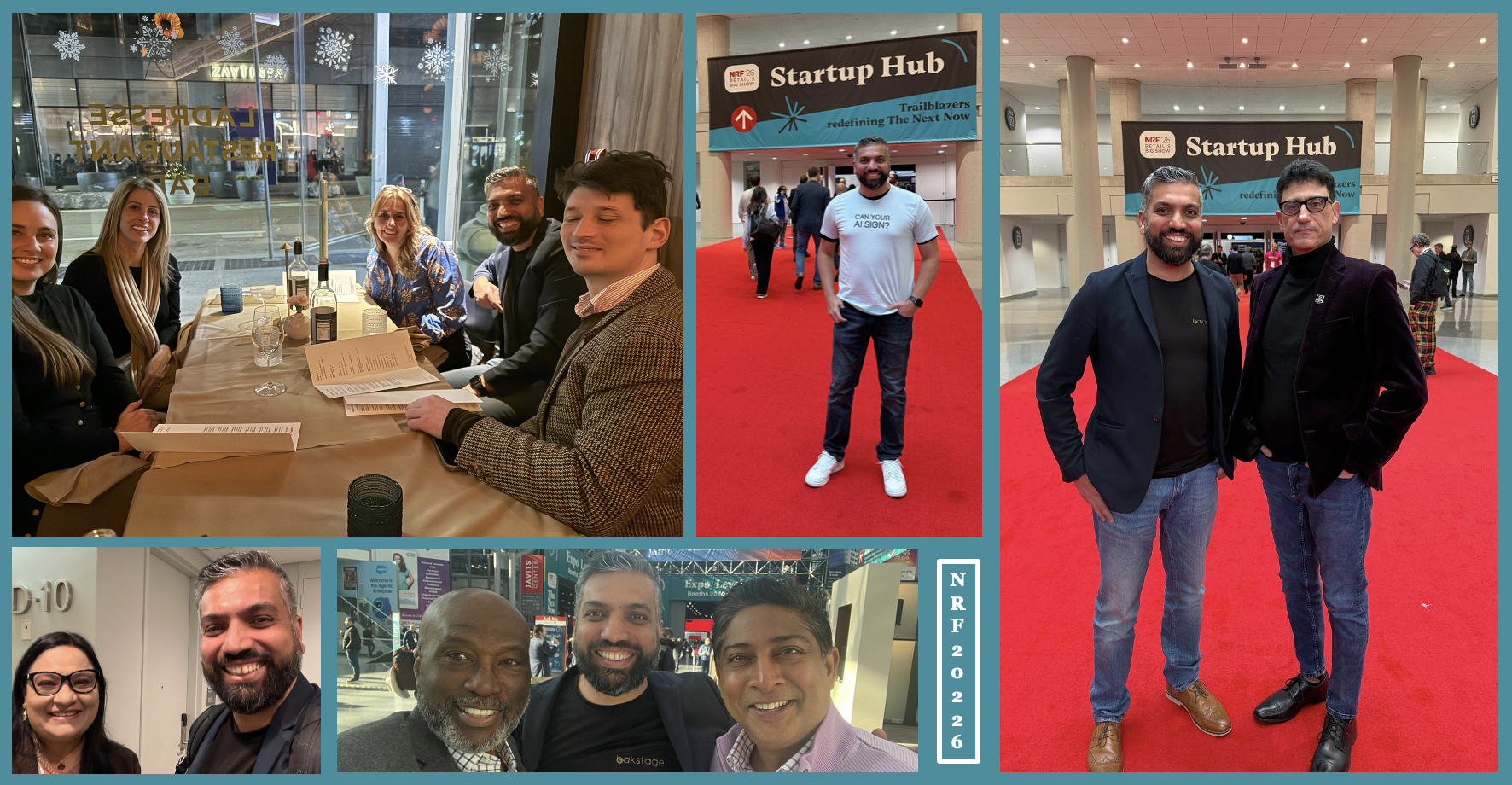
NRF is always about the floor conversations as much as the stage content.
Shashank met senior IBM leaders including Sancia Matthyssen, Elaine Parr, and Aparna Sharma – timely conversations as enterprise retail leans into agentic systems and human-centered customer experiences.
He also represented our partners at 360 Direct Access on the NRF floor – proudly wearing their t-shirt that read, “Can your AI sign?” – a fun (and important) reminder that accessibility needs to be designed into the next generation of AI experiences, not bolted on later.
Shashank also met our partner Wayne Brown from The Walker Group, and we had a great discussion on the intersection of fintech and retail – and how the two are converging through agentic AI workflows.
Here is the convergence we kept coming back to:
- Identity, authorization, and trust become the new “checkout UX” – in an agentic world, the agent must know who the shopper is, what permissions it has, and how to safely transact.
- Payments, offers, and loyalty become programmable in the conversation – instead of “apply coupon at checkout,” agents can surface the best offer, route to the right payment method, and attach loyalty or financing options in real time.
- Risk, fraud, and compliance shift left – fintech-grade guardrails (verification, limits, anomaly detection, audit trails) move earlier into the journey so the agent can execute safely without breaking flow.
- Personalization becomes outcome-driven – agents don’t just recommend products, they can optimize for conversion, margin, lifetime value, and customer satisfaction – while still escalating to humans when needed.
This is exactly why we believe agentic commerce will not be “retail AI” or “fintech AI” – it will be one continuous agentic process across discovery, decisioning, identity, payment, and post-purchase support.
Advisor perspective: Michael Zakkour at NRF
We also had the pleasure of catching up with our advisor Michael Zakkour, who captured the NRF theme perfectly in his LinkedIn post: the “Next Now” is agentic and automated – and, unexpectedly to some, a return to being more human.
That is the line we keep seeing too: the most powerful systems will be the ones that use AI to move faster and operate smarter – while still creating more authentic, human moments that build trust and close.
Bottom line
NRF 2026 was a strong confirmation that commerce is being rewired for agents. Between Voice AI going mainstream at retailers like Lowe’s, and ecosystem moves like UCP trying to standardize agent-to-merchant commerce flows, the direction is clear.
The winners will be the brands that pair:
- agentic automation that executes,
- conversational experiences that feel natural,
- and human escalation (including live video) that builds trust and closes.
That is exactly the lane Bakstage.AI is leading.